
Treatment options

You work with your nephrologist and the healthcare team to develop your treatment plan, including choosing the type of care and dialysis. Below, you’ll find details about each option to help you manage your treatment more effectively.
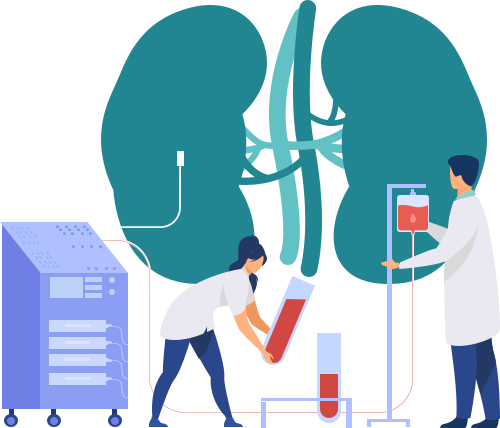

The kidney transplant

The kidney transplant est le meilleur traitement de l’insuffisance rénale terminale. Elle consiste à greffer un rein prélevé sur un donneur et permet le plus souvent de restituer toutes les fonctions rénales.
Read more
Once a transplant is being considered, a pre-transplant evaluation is conducted. If there are no contraindications, the patient with kidney failure is placed on a waiting list.

The kidney to be transplanted may be obtained from:

  • on a deceased person,
  • but also from a living donor. In fact, a healthy person may voluntarily donate a kidney to a family member or close friend, under the conditions set forth by French law. It is possible to live a completely normal life with just one kidney. This is known as living kidney donation.

A kidney transplant can be performed:

  • even before the patient has undergone dialysis, this is known as a preemptive transplant (this is generally the case with living-donor transplants),
  • when he has been on dialysis for some time.

In most cases, it allows patients to return to a nearly normal daily life and achieve good kidney function. However, a immunosuppressive therapy must be taken continuously to prevent rejection of the transplanted kidney. Regular medical follow-up is also essential.

Dialysis centers

To maintain as much independence as possible, home dialysis (hemodialysis or peritoneal dialysis) offers personalized care with sessions tailored to your lifestyle. To help you manage these sessions, we train you and your caregiver and provide the necessary equipment. Our teams stay in touch with you through regular appointments to ensure the effectiveness of your treatment.
You have been trained in hemodialysis and are able to perform all the procedures required for your treatment on your own, but you may need assistance from a nurse for certain procedures.
We can accommodate you if your medical condition is stable and does not require continuous medical supervision during the treatment session (which is monitored remotely).
They will provide care if your medical condition requires the constant presence of a doctor during the session. The center is located near a healthcare facility with inpatient beds (internal medicine, surgery, intensive care, and emergency services).
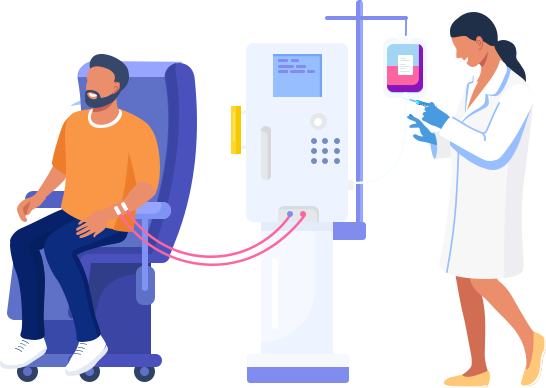
Hemodialysis

At home:

3 to 6 times a week
2 to 4 hours per session

In center or Medical Unit or in Autodialysis

3 sessions of 4 hours each per week
This is a method of blood purification that involves creating an extracorporeal circulation circuit and passing the blood through a dialysis membrane (artificial kidney). The sessions are performed by creating a fistula or inserting a central catheter to facilitate access to the bloodstream.

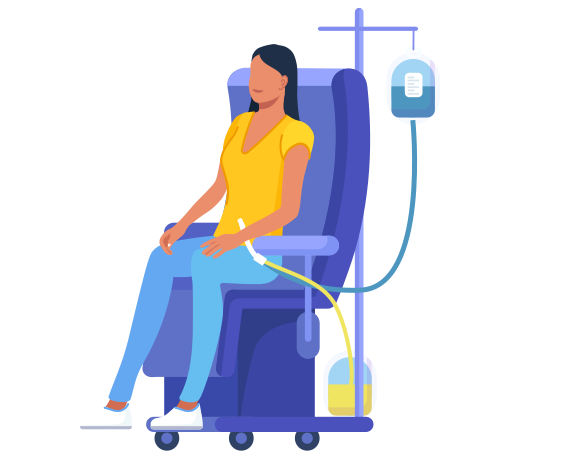
Peritoneal dialysis

This is a dialysis technique in which the peritoneum—a natural, highly vascularized membrane that surrounds all the digestive organs—serves as the filter. It is performed by inserting an intraperitoneal catheter.
Read more

You learn the technique in a training unit and then perform dialysis at home, with or without the assistance of a nurse. Because the procedure is technically simple, you can maintain your independence.

Continuous Ambulatory Peritoneal Dialysis:

The abdominal cavity is constantly filled with dialysate, and the bags are replaced manually.

Duration:20 minutes several times a day Location:Home
Automated Peritoneal Dialysis:
Using a cycler ensures that the purification process, which is usually carried out at night, is performed automatically.

Duration: 8 to 12 hours a day